
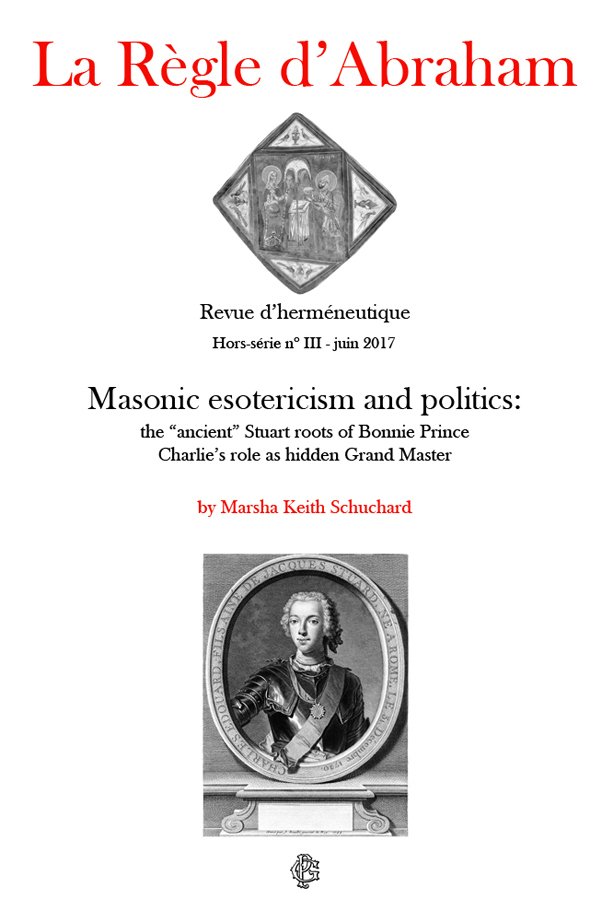
La Règle d’Abraham — Hors-série III
Masonic Esotericism and Politics
The “Ancient” Stuart Roots of Bonnie Prince Charlie’s Role as Hidden Grand Master
- Publicado el 27 de mayo de 2017
- 114 páginas
- 20 ilustraciones
- Texto en inglés
Impreso bajo pedido y enviado directamente a su dirección, normalmente en 1 a 2 semanas.
Libreros, pago con cheque o cualquier otra consulta: GP.editeur@gmail.com
Presentación
Table of contents:
Introduction
Swift, Lull, and the masonic Art of Memory
Stuart freemasonry and solomonic architecture
Jacobite versus Hanoverian rivalries
Mar, Ramsay, and the restoration of Stuart freemasonry
“Bonnie Prince Charlie” emerges on the masonic stage
The Royal Order of Heredom and Kilwinning
The ancient chivalry of the Temple of Jerusalem
The fates of the Jacobite Grand Masters
The hidden Grand Master and the Écossais network
Old world royalists and new world revolutionaries
Restoring the Temple in the North
Conclusion
Acerca de la revista
Mainly focused on the study of esoteric traditions within the three monotheist Revelations, La Règle d'Abraham is a periodical founded and directed by Patrick Geay since April 1996. This special edition in English, with 20 rare Masonic illustrations in color, is dedicated to an important article by Marsha Keith Schuchard on Masonic esotericism and politics: the “ancient” Stuart roots of Bonnie Prince Charlie's role as hidden Grand Master
Research into Charles Edward Stuart's alleged affiliation with Jacobite or Ecossais Freemasonry has long been hampered by the misleading assumption, which became academic "conventional wisdom," that Freemasonry virtually began in England when the Grand Lodge of London was formed in 1717. Moreover, it was generally characterized as non-political and rationalistic, devoted to the Protestant succession, the Hanoverian government, Newtonian science, and latitudinarian religion. However, the recent international expansion of Masonic and Jacobite studies makes possible a more credible and documented study of the Stuart prince's political and Masonic activities, within a context of anti-Hanoverian, politically-active, diplomatically-diverse, and spiritually-oriented Masonry that draws upon the early Scots-Irish traditions maintained by the Stuart kings in Greater Britain and by the exiles in the Jacobite diaspora. Ranging from the 1590s in Scotland to the 1780s in Italy, the Stuart-Masonic themes of Jewish mysticism, Lullist illuminated knighthood, Solomonic architecture, and religious toleration sustained the military and political campaigns of James II, James III, and "Bonnie Prince Charlie" in their struggle to reclaim the thrones of their ancestors.